
 Hamnet is a story of family, loss and overwhelming grief. The story begins with an historical Note advising the reader that “Hamnet died in 1596, aged eleven. ~Four years or so later, the father wrote a play called Hamlet.”
The story begins at Hamnet’s home in Stratford, where his twin sister Judith has fallen extremely ill, the house is empty and Hamnet is desperately seeking help. “This moment is the absent mother’s: the boy, the empty house, the deserted yard, the unheard cry.” His mother is at Hewlands, her prior home, working with her bees. His older sister, Susanna is with their grandmother Mary out selling gloves. His Father is in London where he works and his grandfather, a frightening figure, slaps him for hanging around. At the beginning stages of the story we learn that the grandfather, John, is a disgraced business man who has fallen from a position of respect. The reasons for the fall are not quite clear but his business dealings are fraught. He is known to beat his children.
The first part of the book shifts, on a chapter by chapter basis, from Hamnet’s story until his death, to the story of how his parents met. As a young man, his Father, who is never identified by name (Shakespeare of course!), is indentured to a farming family to tutor the family’s boys in Latin. The indenture is intended to pay off John’s debt to the family. One day while tutoring the boys the Father sees a young woman who strikes him. He begins to talk to her, thinking she is a servant of the household and quickly falls for her. The woman is Agnes, the daughter of the farmer who had died a number of years before. She lives on the farm with her brother, Bartholomew, stepmother, Joan and many half siblings. Her father had left her a significant dowry. Her stepmother treats her terribly.
Agnes is rumored to be “strange, touched, peculiar, perhaps mad.” In reality, she has the ability to see a person’s future and has an innate knowledge of plants and their healing powers. When Joan refuses the Father’s request to marry Agnes, Agnes makes the decision to become pregnant, thereby forcing the issue. “We can, she said, take matters into our own hands.” Of course Agnes and the Father marry and they move into an apartment in John and Mary’s house. At the wedding Bartholomew, who is described as very large and strong, whispers to the Father, “’Take good care of her, Latin boy, very good care, and no harm will come to you.”
Although it is Judith who is very ill, she survives and Hamnet succumbs to the plague. Agnes is inconsolable and the Father does not get back to Stratford from London before Hamnet dies. They bury their son and then the Father announces that he must get back to London, where he runs a playhouse. The second part of the novel focuses on grief and the relationship between Agnes and the Father. The description of profound grief in all its phases takes the reader deep into the family’s pain.
After Hamnet’s death, the Father’s visits to Stratford become less frequent and his correspondence also becomes less frequent. Agnes questions his faithfulness. Agnes discovers, through her stepmother, Joan, that the Father has written and is producing a play in London called Hamlet. Agnes is furious and she and Bartholomew travel to London on horseback to see the play. It is while she is watching the play that she suddenly understands her Husband’s deep grief.
There are a lot of other things going on in the novel—character studies, sixteenth century superstitions, friendships and more. However, the novel is mostly about grief. It is beautifully written and very sad. The novel won the 2020 Women’s Prize. You can reserve Hamnet at the Cuyahoga County Public Library by clicking here.
From Briefs to Books was recently featured in Ohio and Kentucky Super Lawyers Magazine. To see the feature in Super Lawyers, click here.
 “Homeland Elegies” is a complex, part novel, part memoir about an American Muslim’s complicated relationship with his country and his family. The novel begins with a letter from the author to his readers, explaining the intent of the novel. “I wrote Homeland Elegies in something of a fever dream after my mother passed away, and after Donald Trump’s election…I wanted to remember what it was that brought them here…fifty years ago…Above all, I wanted to remember what this half-century had been for us…Elegies, then, for homelands of various sorts, as told by the child of a generation, caught between notions of home, of success, of belonging, and most of all, of America.”
 “The Cold Millions” is a big (figuratively speaking) beautiful work of historical fiction. The story revolves around the very real 1909 organizing and fundraising campaign of the Industrial Workers of the World (IWW) in Spokane, Washington and the also very real activities of Elizabeth Gurley Flynn.
 “Monogamy” is an exploration of marriage, family and friendship. Sometimes the people in those relationships are happy and sometimes, apparently most of the time, they are misunderstood and unknowable.
 “Jack” is a love story…sort of. The time is uncertain, post-World War II, and Jack is living in St. Louis, recently released from prison. He meets Della, and they fall in love.
 “The Night Watchman” is a snapshot of the Turtle Mountain Band of Chippewa during a very eventful time in 1953-1954. As best explained by the author, “On August 1, 1953, the United States Congress announced House Concurrent Resolution 108, a bill to abrogate nation-to-nation treaties, which had been made with American Indian Nations ‘for as long as the grass grows and the rivers flow'”. This effort attempted to terminate five tribes, including the Turtle Mountain Band of Chippewa.
 “The Splendid And The Vile” focuses “on Churchill’s first year as prime minister, May 10, 1940 to May 10, 1941, which coincided with the German air campaign as it evolved from sporadic, seemingly aimless air raids to a full-on assault against the city of London.” The book “is a more intimate account that delves into how Churchill and his circle went about surviving on a daily basis; the dark moments and the light, the romantic entanglements and debacles…” This limited history is simply splendid (and not at all vile).
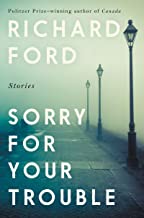 “Sorry for Your Trouble” is a collection of nine short stories by one of my favorite authors, Richard Ford. In each story there is some connection to Ireland and there is always a lawyer. Most of the stories involve a man in late middle age who has a connection to New Orleans or some other town in Louisiana. And each story has an existential end of life feel to it.
 ALERT: this review is one giant spoiler. It is impossible to give you a sense of this book without giving away the key aspects of the plot. So let me start with a few points before you decide to read on. First, if you do not like Hillary Clinton, do not read this book. However, if you do not like Bill Clinton, you might want to read this book! Are you torn? A few more things before you decide to read on. Curtis Sittenfeld is not a great writer. She is good enough but not really all that good. The book is too long and bogs down on things like Hillary’s sex life and campaigning. The story, however, is incredibly clever.
 “A Long Petal Of The Sea” is a moving, brilliantly conceived historical novel that follows the lives of Victor Dalmau and his wife, Roser, through the Spanish Civil War, the Chilean coup and beyond. The novel describes human cruelty, strength and perseverance through a compelling and emotional form of storytelling that is quintessential Isabel Allende.